


Blog
Complete Guide to Ship Main Engines: 2-Stroke vs 4-Stroke Design, Operation & Spare Parts

2-Stroke vs 4-Stroke Marine Engines
Most of the world’s commercial ships have main engines that are either 2-stroke or 4-stroke, depending on the size of the ship and its needs. This guide breaks down their basic design ideas, how they work, what makes them different, and what extra parts are needed for regular upkeep.
Design of a 2-Stroke Engine
Every two piston strokes – one down and one up – 2-stroke marine diesel engines complete a power cycle. This makes them perfect for huge ships like container ships and tankers that need to move slowly but have a lot of torque. They have enormous bore diameters (up to 1 meter) and long strokes that make burning heavy fuel oil more efficient. Crosshead designs separate the forces of the piston and connecting rod so that they can withstand very heavy loads. Scavenge apertures in the cylinder liner and exhaust valves in the cylinder head let new air push out exhaust gases in a uniflow or loop scavenging system.
Cycle of 2-Stroke Operation
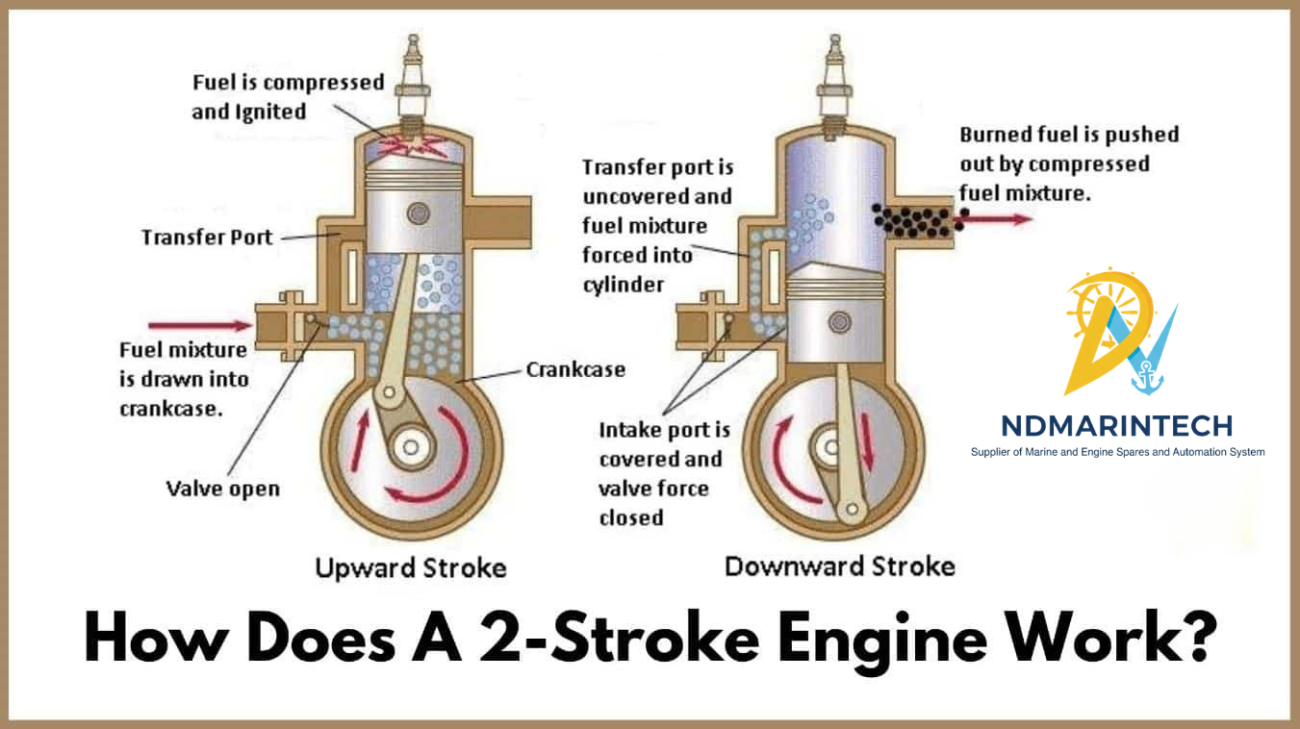
The cycle starts at bottom dead center (BDC). The piston rises and compresses the scavenge air to 30–40 bar and 500–600°C before reaching top dead center (TDC). Fuel injectors spray heavy fuel oil at TDC. The heat from the compression ignites the oil, which pushes the piston down in the power stroke and turns the crankshaft once each cycle.
Near BDC, the exhaust ports open to let the blowdown happen. Then, the scavenging ports open to let in turbocharged air. This completes the cycle in one revolution, giving 4-strokes twice the power impulses.
Design of a 4-Stroke Engine
Four-stroke engines need four piston strokes for every two crankshaft revolutions. This makes them good for medium-speed jobs on ferries and supply ships and as extras on big ships. With trunk piston designs, the connecting rod is directly connected to the piston, and overhead camshafts control the inlet and exhaust valves for accurate timing. Smaller bores and higher RPMs (300–1000) make it possible to design smaller engines, often with turbochargers to improve air intake.
Cycle of Operation for 4-Stroke
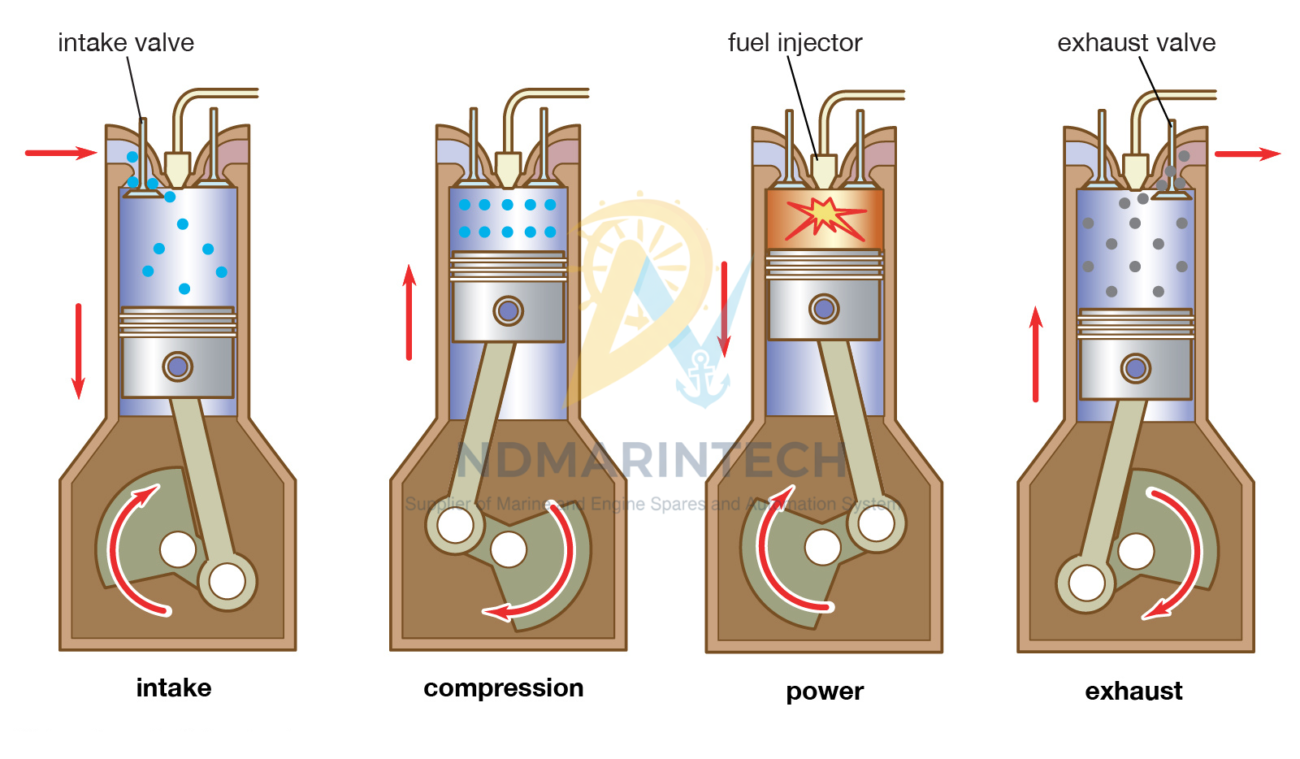
Intake stroke: The piston moves down from TDC with the inlet valve open, pulling in clean air. Compression stroke: as the piston rises, both valves close, squeezing the air until it reaches the temperature at which it ignites. Power stroke: gasoline is injected close to TDC, and the combustion pushes the piston to BDC. Exhaust stroke: the exhaust valve opens, the piston rises to push out gases, and this happens every two revolutions for smoother but less frequent power delivery.
Design Comparison
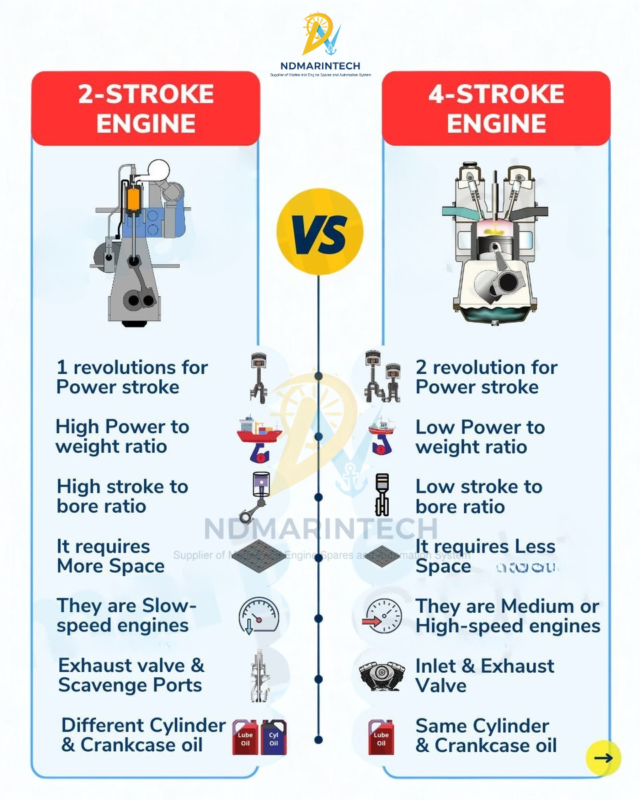
| Aspect | 2-Stroke Engines | 4-Stroke Engines |
|---|---|---|
| Power Strokes | Every crankshaft revolution | Every two revolutions |
| Speed | Low (80-150 RPM) | Medium/High (300-1000 RPM) |
| Weight/Power Ratio | Higher power-to-weight | Lower, more parts |
| Fuel Flexibility | Heavy fuel oil tolerant | Cleaner fuels are preferred |
| Drive System | Direct to propeller | Often needs reduction gears |
Advantages of 2-Stroke Engines:
2-stroke engines are better for long trips since they use less gasoline and burn cheaper heavy fuels. They also need less maintenance because they have fewer moving parts and don’t need separate intake and exhaust strokes. They can simply be turned around by changing the timing of the injection and exhaust.
With complete combustion cycles, 4-strokes run quieter, make fewer emissions, and don’t lose power when ports overlap. They also work well with dual-fuel LNG installations. But 2-strokes need careful scavenging to keep oil from mingling and causing scavenging fires.
Important Spare Parts: 2-Stroke
According to the rules, you must have one set of main bearings for each size, thrust pads, and piston rings for all cylinders. Failures in these parts cause 70% of breakdowns: cylinder liners, piston crowns/skirts, exhaust valves, fuel injectors/nozzles, turbocharger bearings, and connecting rods. Stock O-rings, gaskets, and fuel pump plungers keep things from getting delayed. MAN B&W MC-series engines like the 6S50MC need anti-polishing rings to keep their liners from wearing out.
4-Stroke Critical Spare Parts
Pay special attention to the valve trains, which include the cylinder heads, camshafts, inlet and exhaust valves, and valve seats, as they wear out at high RPMs. Fuel injectors, turbochargers, piston rings, liners, and lubricating oil pumps are all important. The Wärtsilä 32 and MAN L27/38 models put charge air coolers and bearings at the top of the list. To follow class requirements, you must have a full set of filters and injectors.
Best Practices for Maintenance
- For 2-strokes, check the cylinder pressures, exhaust temperatures, and scavenge air every day.
- For 4-strokes, check the valve clearances and the lubrication oil analysis.
- Every 20,000 to 30,000 hours, you should overhaul 2-strokes, paying special attention to the liners and pistons.
- 4-strokes need valve grinds every 10,000 hours.
- Use vibration sensors to monitor the status of your equipment and predict problems. This will increase TBO by 20%.
- To avoid problems with your warranty, always check that spare parts are compatible with the original equipment manufacturer (OEM).