

Blog
Modular vs Compact PLCs for Ship Control Systems: Applications & HMI Guide


In the tough field of marine engineering, choosing the correct Programmable Logic Controller (PLC) for ship control systems may make or break safety, efficiency, and long-term costs. Modular PLCs are the most flexible option for adding more engine monitoring and automation systems, while compact PLCs are the most cost-effective option for smaller, fixed applications. This article explains both modular and compact PLCs, how to use them, how to scale them up, and how to integrate them with HMIs. This will assist ship operators and engineers make the right choice. At ndmarinetech.com, we have all kinds of marine automation tools.
Both modular and compact PLCs can control and monitor ship engines, but they are very different when it comes to how effectively they scale, work with HMIs, and enable long-term automation updates on board.
What are modular and compact PLCs?
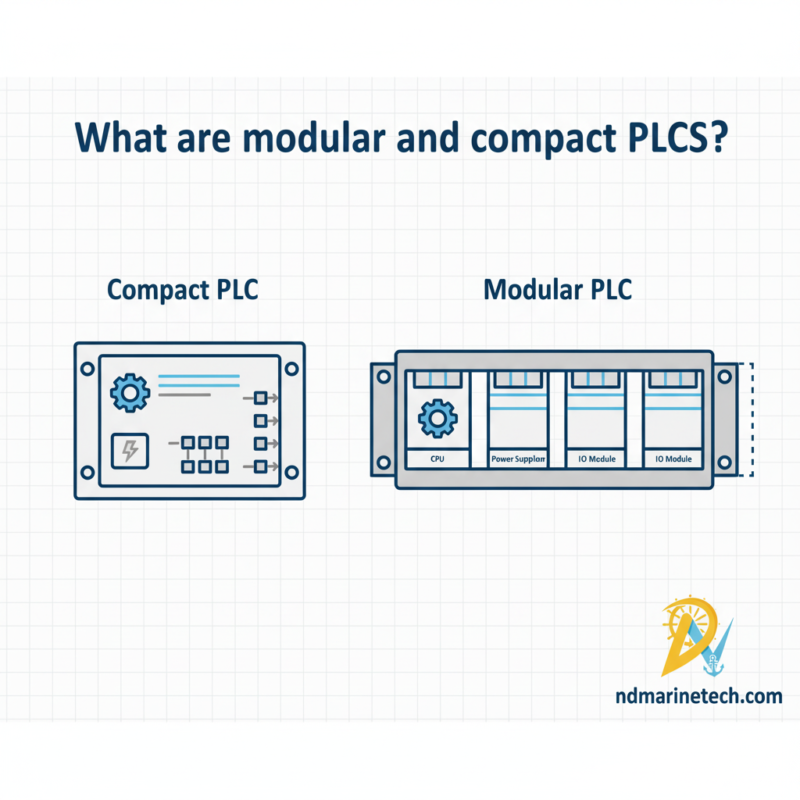
-> Compact PLCs have a CPU, power supply, and a set number of I/Os all in one chassis. This keeps the size and cost down, but it also limits the choices for growth.
-> With modular PLCs, the CPU, power supply, communication, and I/O modules are all in separate racks or chassis. This way, you may add or swap cards as the automation needs of the vessel expand.
In real life, compact PLCs are best for simple, steady control jobs, whereas modular PLCs are best for complicated marine automation that can be expanded in the future.
Uses in ship control systems
1) Common usage for compact PLCs at sea include independent pump skids, single auxiliary systems, small winches, or local panels with a limited number of inputs and outputs that are not expected to change.
2) Common uses for modular PLCs include automating the engine room, managing power, controlling propulsion, setting up centralized alarm and monitoring systems, and creating I/O networks that work throughout the ship.
3) PLC-compatible gateways or PLCs are used as the main hub in many current maritime monitoring systems. They gather data from engines, generators, switchgear, and other systems and send it to HMIs in the wheelhouse.
Scalability and lifecycle onboarding
Shipowners and yards frequently care more about scalability and lifespan cost than the lowest initial hardware price.
- Compact PLCs take up less space on the panel and cost less on the first day, but adding more I/O or other communication choices later usually entails changing the whole controller.
- Modular PLCs are made to be able to grow. You may add more racks, remote I/O, and new communication or specialist modules (such safety, motion, or condition monitoring) without having to redesign the whole system.
- In the marine environment, being able to replace only one broken module instead of the whole controller cuts down on downtime and spare parts costs, which is very important for mission readiness and charter schedules.
When to choose compact vs modular
| Aspect | Compact PLC (Ship Use) | Modular PLC (Ship Use) |
|---|---|---|
| Typical scope | Single skid, small local control panel, simple auxiliary system. | Engine room automation, power management, vessel-wide alarm/monitoring. |
| I/O capacity | Limited, fixed I/O; minor expansion via small add-on blocks only. | Very high; add racks and remote I/O to match system growth. |
| Scalability | Poor; major upgrades usually require new PLC. | Excellent; add or replace modules as needed. |
| Maintenance | Replace complete unit on serious fault. | Replace only the faulty card/module; easier troubleshooting. |
| Best for | Stable systems, limited budget, tight space. | Long-life vessels, phased upgrades, complex automation. |
Integration with HMIs for monitoring engines
On ships, HMIs are the main way to get engine alarms, trends, and control, therefore PLC–HMI integration needs to be dependable and adaptable.
- Marine-grade HMIs can talk to both compact and modular PLCs across conventional protocols like Modbus TCP, Ethernet/IP, and vendor-specific protocols (like Siemens S7). This lets you see live engine and generator data in the wheelhouse.
- When you combine propulsion, generators, tank levels, and other gear into one HMI architecture, modular PLC systems usually support more networks and data points at the same time.
- Some marine solutions can employ an HMI and a gateway as a stand-alone monitoring system when there isn’t a full PLC-based control system. This is great for tiny boats or retrofits.
Design considerations for marine PLC systems
- Use clear warning hierarchies, color coding, and mimic diagrams for engines, generators, and other systems to help people in the engine control room and on the bridge make quick judgments.
- Make sure there are extra ways to communicate (such ring networks with media redundancy protocols) if classification standards or operational risk call for enhanced availability.
- Make sure that tags and data structures in the PLC are the same so that HMIs, data loggers, and remote monitoring platforms can all read the same information on the ship.
A useful guide for choosing marine projects
When you design or improve ship control systems, utilize these tips to decide between modular and compact PLCs.
1) Choose compact PLCs when: the function is basic and isolated, the number of I/Os is minimal and unlikely to develop, there isn’t much room on the panel, and it’s okay to “swap the whole unit” for maintenance.
2) Choose modular PLCs when you need to connect systems in the engine room and on the deck, there is a clear plan for installing new equipment, high availability and maintainability are required by classification or owner requirements, or HMI and remote monitoring needs are complicated.
3) A modular PLC with marine-grade HMIs and redundant networking is the best way to make sure that most recent engine monitoring and automation packages aboard commercial ships will work in the future.
If you are planning or upgrading ship control and monitoring, you can source PLC hardware, I/O modules, HMIs, communication accessories, and marine automation spares through your own specialist supplier at ndmarinetech.com, where all types of marine and industrial automation components are offered for different vessel sizes and applications.