


Blog
Why Power Supply Aging Kills PLCs and Drives in Marine Automation?


In marine automation, not many engineers know that power supply aging are one of the main hidden reasons why PLCs and VFD drives fail too soon, leading to annoying trips, blackouts, and expensive downtime. As electrolytic capacitors dry out, parts move around, and heat and vibration take their toll, shipboard power sources start sending out noisy, unstable 24 VDC that quietly damages delicate control electronics long before they completely fail. Fleet managers, ETOs, and service engineers can make systems more reliable, hardware last longer, and avoid costly emergency yard trips by learning why aging power supplies kill PLCs and drives in marine automation and how to find and stop it.
In maritime automation systems, healthy power supplies are what keep PLCs and variable frequency drives (VFDs) working properly. When those power sources get old, they stealthily destabilize control voltage, damage electronics, and finally kill important PLC and drive gear, frequently without any clear warning.
Why Power Supply Aging Kills PLCs and Drives in Marine Automation

How Power Supplies Age on Ships?
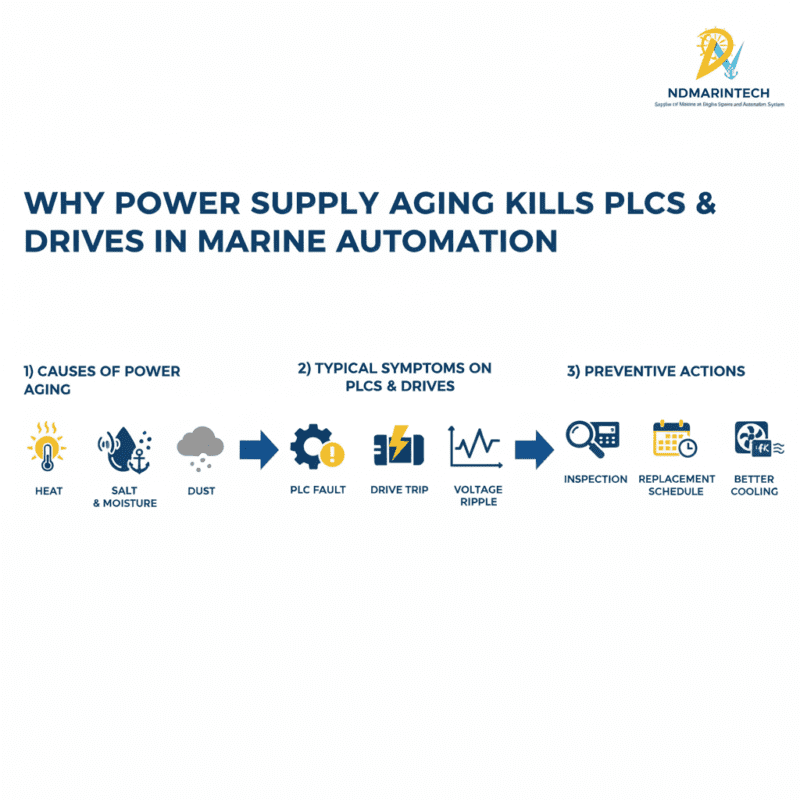
Conditions on board ships speed up the aging of power supplies compared to plants on land.
- Engines, pumps, and rough seas that shake things up all the time wear out solder joints, connectors, and PCB tracks.
- When the temperature inside packed panels is high, it dries out electrolytic capacitors and puts stress on semiconductors.
- Corrosion happens on terminals, heat sinks, and internal parts when the air is damp and salty.
- Dust, oil mist, and carbon particles get stuck in filters and make cooling less effective, which makes the inside temperature go up.
- Over time, these stressors slowly strain power supplies outside of their initial design limits, even if they still seem to work.
What Aging Does Inside a Power Supply?
The aging processes that happen inside SMPS (switch-mode power supply) and linear supplies have a direct impact on the quality and stability of the output.
- Capacitance decreases and ESR increases in electrolytic capacitors. This causes more ripple and poor filtering on DC outputs.
- When the load changes, opto-couplers and feedback parts drift, which makes voltage regulation slower and less precise.
- When semiconductors (MOSFETs, diodes, regulators) are pressured by heat, they are more likely to fail at random times.
- Microvolt drops and intermittent disconnections can happen on 24 VDC control lines when connectors are corroded or loose.
- The end effect is a power supply that still works, but sends PLCs and drives loud, unreliable, or low voltage.
How Aging Power Supplies Kill PLCs
- Low DC voltage and dips can cause random PLC resets, watchdog tripping, and CPU “hangs.”
- Too much ripple and noise on 24 VDC lines mess with the precision of analog inputs and produce incorrect digital transitions.
- Brownouts that happen again and over again can harm flash storage, corrupt PLC memory, and limit the life of CPU modules.
- Bus faults, “missing” module problems, and annoying alarms might happen when distant I/O or communication cards don’t get power all the time.
How Aging Power Supplies Damage Drives?
Power quality has a big effect on the drives for pumps, fans, thrusters, and winches.
- Bad front-end supplies or UPS systems can make the DC bus unstable, which can cause overvoltage/undervoltage trips and drive shutdowns.
- Bad control supply (for drive control boards and I/O) can cause the start and stop behavior to be unpredictable and the parameters to become corrupted.
- Power cycling during dips puts a lot of stress on drive power modules (IGBTs) and DC-link capacitors.
- Conditions with a lot of harmonics or noise make EMI problems worse, which can cause encoders to lose out and communication difficulties.
- In the end, a drive that has been getting only a little power for years often fails badly when you need it the most, during a heavy maneuvering or hauling operation.
Why Marine Automation Is Extra Vulnerable
Marine control systems work in very difficult conditions and are very important.
- Single-point failures: A lot of ships still use only a few PLCs and drives to move, steer, and handle cargo.
- Hard to get to: Panels are often put in hot, tight spaces with bad airflow and not much room to work.
- 24/7 operation: Important systems run all the time, so there isn’t much time for maintenance or diagnostics that require access.
- Safety and compliance: A blackout caused by a power outage might cause loss of propulsion, steering problems, or not following class and flag rules.
- This means that old power supplies are not only a maintenance issue, but also a safety and regulatory danger.
Early Symptoms Engineers Should Watch
- More and more PLC I/O problems that can’t be explained, intermittent communication errors, and “ghost” alarms.
- Drives that trip when the voltage is too low, too high, or there is a problem with the DC bus during load changes or switching generators.
- Fans running all the time, panels running hotter than they used to, or power supply PCBs that are changing color.
- When under stress, the measured 24 VDC was closer to the lower limit (22–23 V), and there was a noticeable ripple on a scope.
- Don’t just think of these symptoms as separate control problems; think of them as warning signs for the health of the power supply.
Best Practices to Prevent PLC and Drive Death
Set replacement intervals: For example, in extreme marine settings, power supplies and capacitors should be treated as consumables and replaced every 7 to 10 years.
1) Do load and ripple testing on a regular basis: Check the voltage under real load and measure the ripple, not only the open-circuit voltage.
2) To keep the panel cool, add ventilation, lower the power supply, and make sure that air can circulate freely inside.
3) Use conformal-coated supplies, IP-rated enclosures, and the right cable glands to keep salt and moisture out.
4) Keep terminations clean by regularly tightening them, cleaning up any corrosion, and looking for discolouration or hot spots.
5) When you plan ahead to replace power supplies, PLCs and drives live longer, and you don’t have to deal with a chain of “secondary” failures.
Verdict:
Aging power supplies aren’t just another spare part problem; they are often the cause of “mystery” PLC faults and drive trips in marine automation systems, especially when circumstances are tough aboard ships and power quality changes. The only way to keep your PLCs, VFDs, and uptime safe is to treat DC power as a valuable resource by keeping an eye on voltage and ripple, planning ahead for replacements, and building in redundancy and derating into new builds and retrofits instead of waiting for the next blackout to show how weak the supply is.