



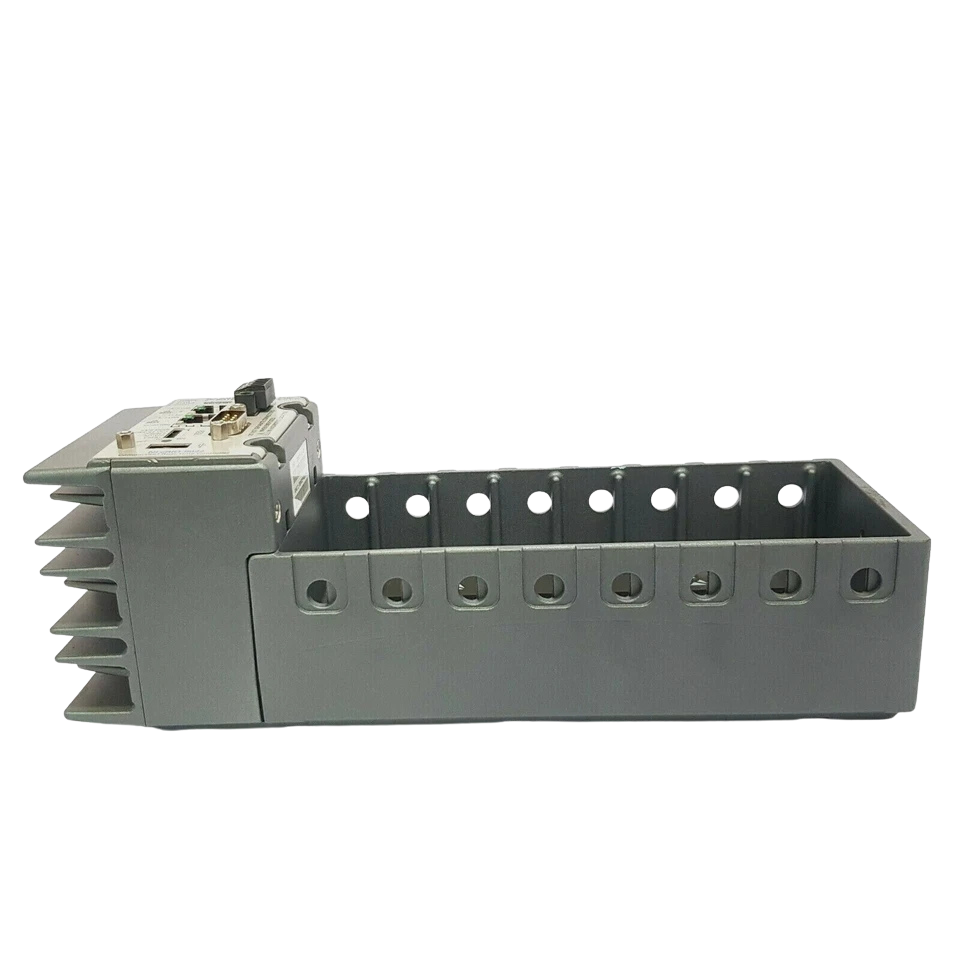
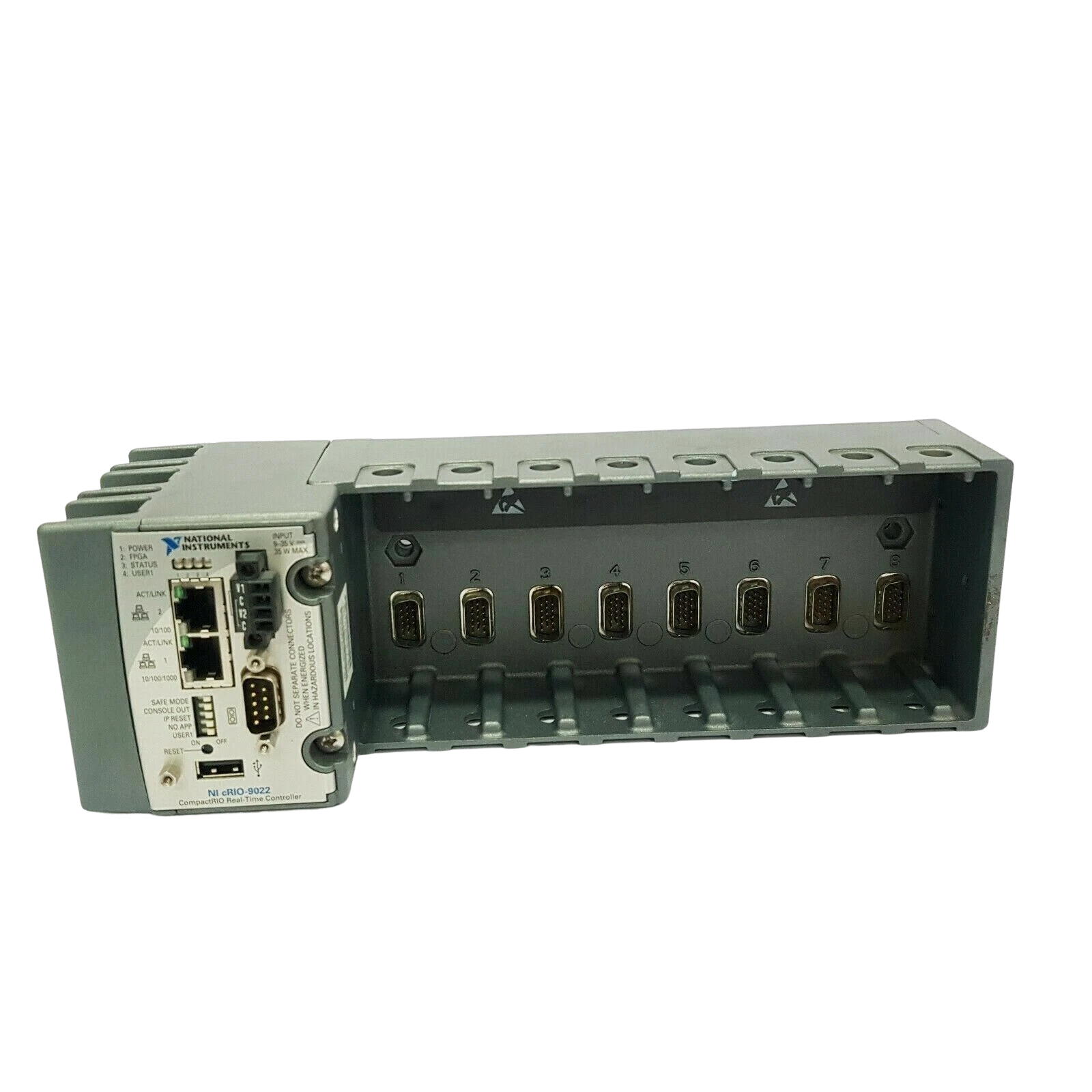
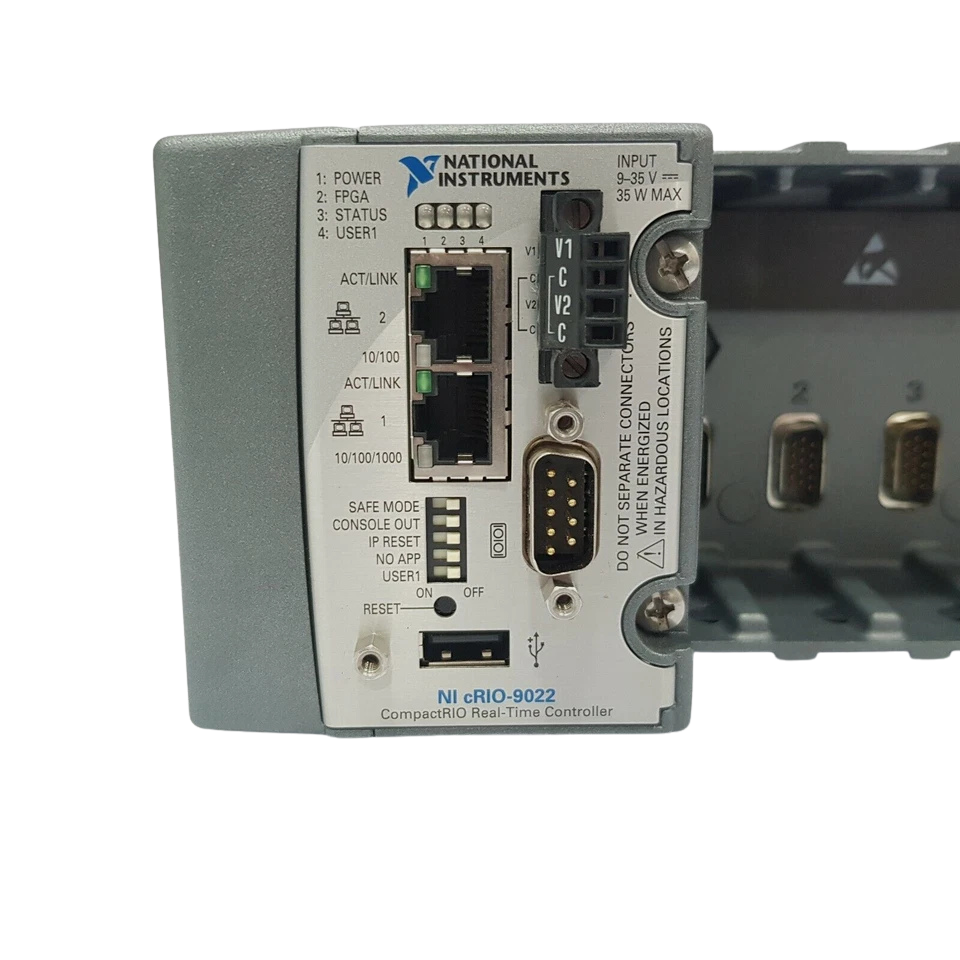
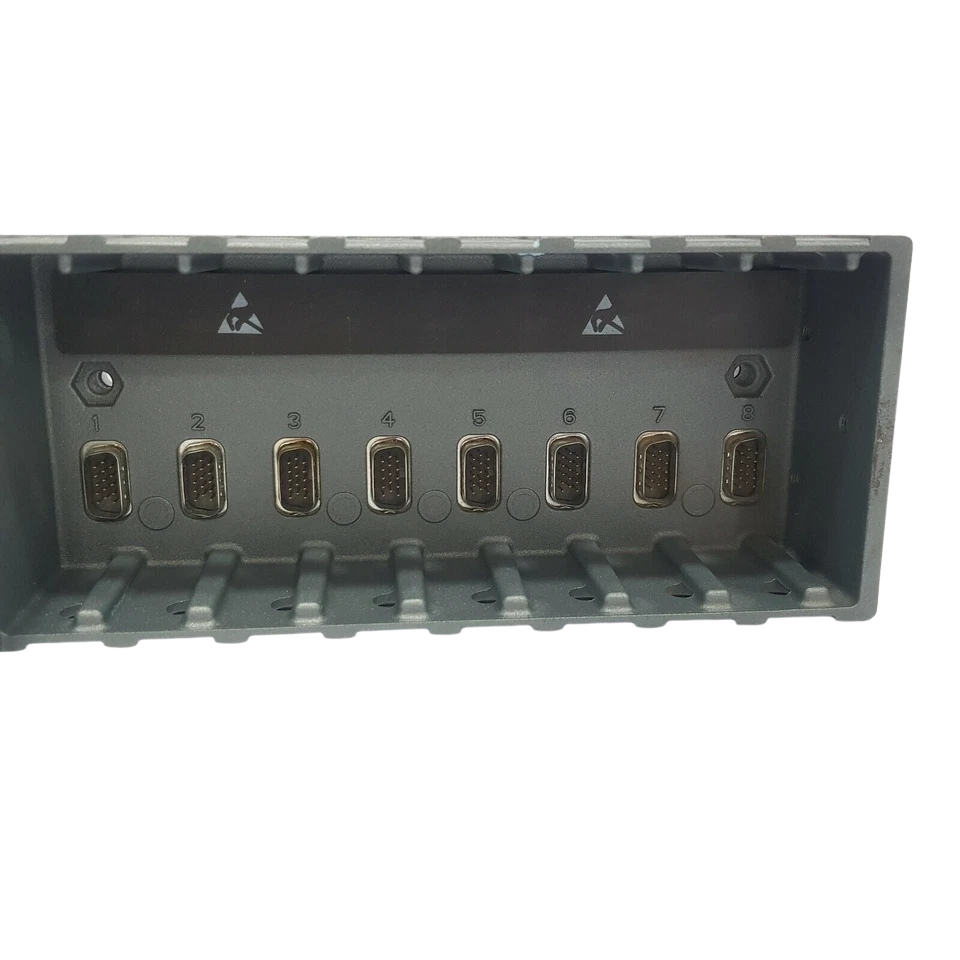
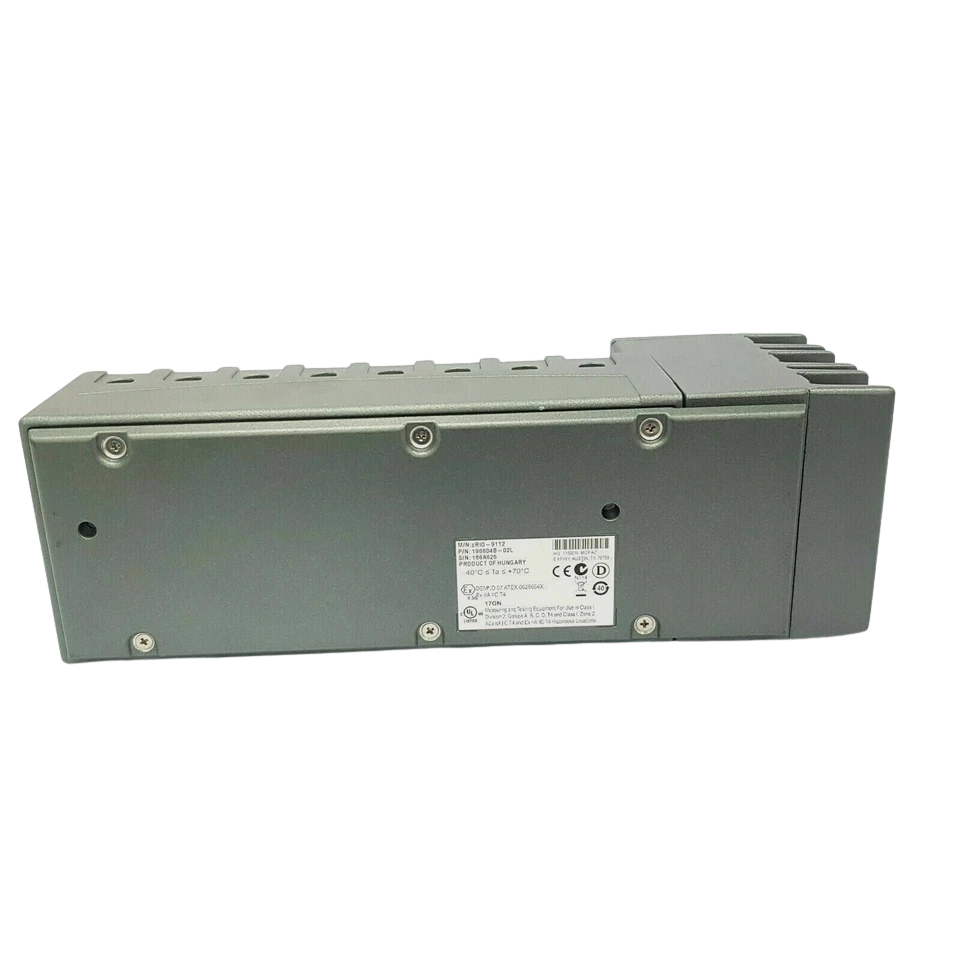
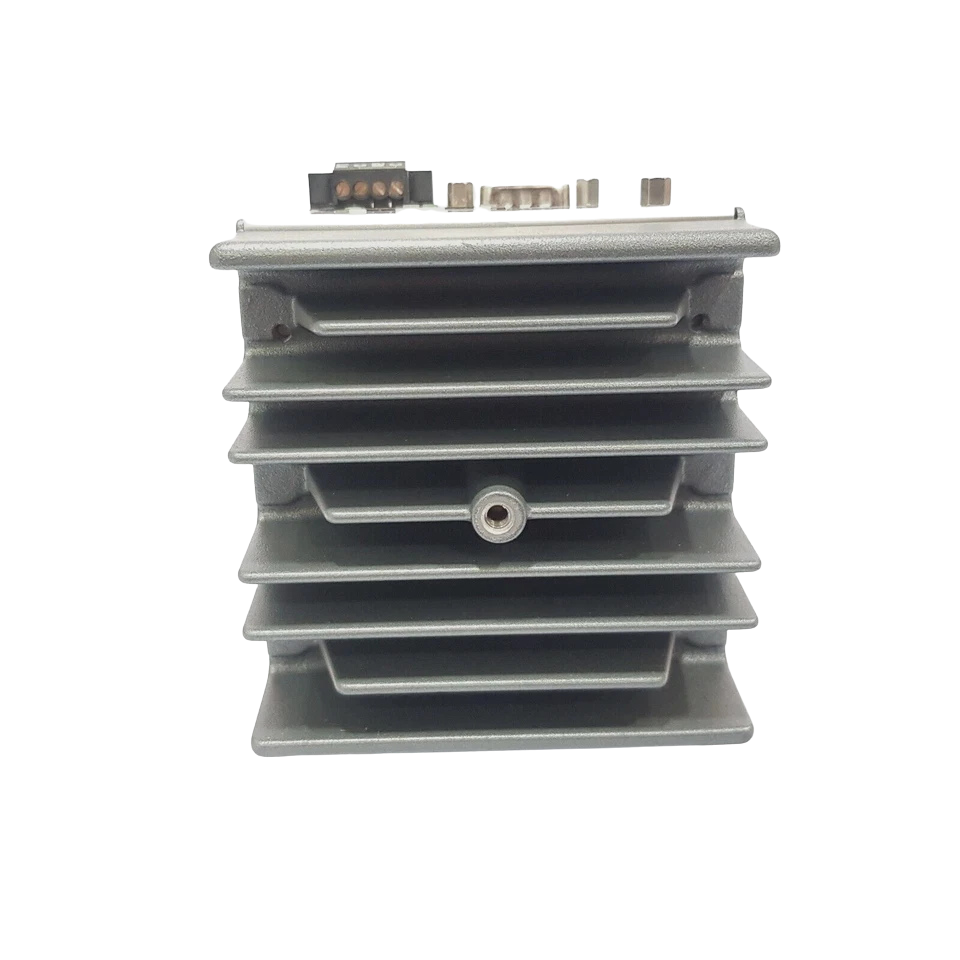




The National Instruments cRIO-9022 combined with the cRIO-9112 reconfigurable embedded chassis forms a high-reliability Programmable Automation Controller (PAC) engineered for deterministic control, high-throughput condition monitoring, and hardware-timed instrumentation.
At the processing tier, the cRIO-9022 is driven by a 533 MHz Freescale MPC8347 PowerPC real-time processor executing on Wind River VxWorks RTOS. It features 256 MB of DDR2 DRAM and 2 GB of onboard nonvolatile solid-state storage, providing sufficient overhead for local data persistence, headless black-box logging, and deterministic control loops running independently of external supervisory hosts. Dual Ethernet ports (one Gigabit, one Fast Ethernet) provide independent interfaces for supervisory SCADA communications and deterministic expansion I/O.
At the physical I/O layer, the controller mechanically and electrically interfaces with the cRIO-9112 8-slot reconfigurable chassis. The chassis integrates a Xilinx Virtex-5 LX30 FPGA featuring 19,200 logic cells (flip-flops and 6-input LUTs) and 1,152 kbits of embedded block RAM. This FPGA connects directly to each of the eight C Series I/O module slots via dedicated lines, executing user-defined hardware logic at internal timebases up to 40–200 MHz for nanosecond-level timing, high-speed filtering, and custom interlock execution.
Model Details
- Controller Model: cRIO-9022
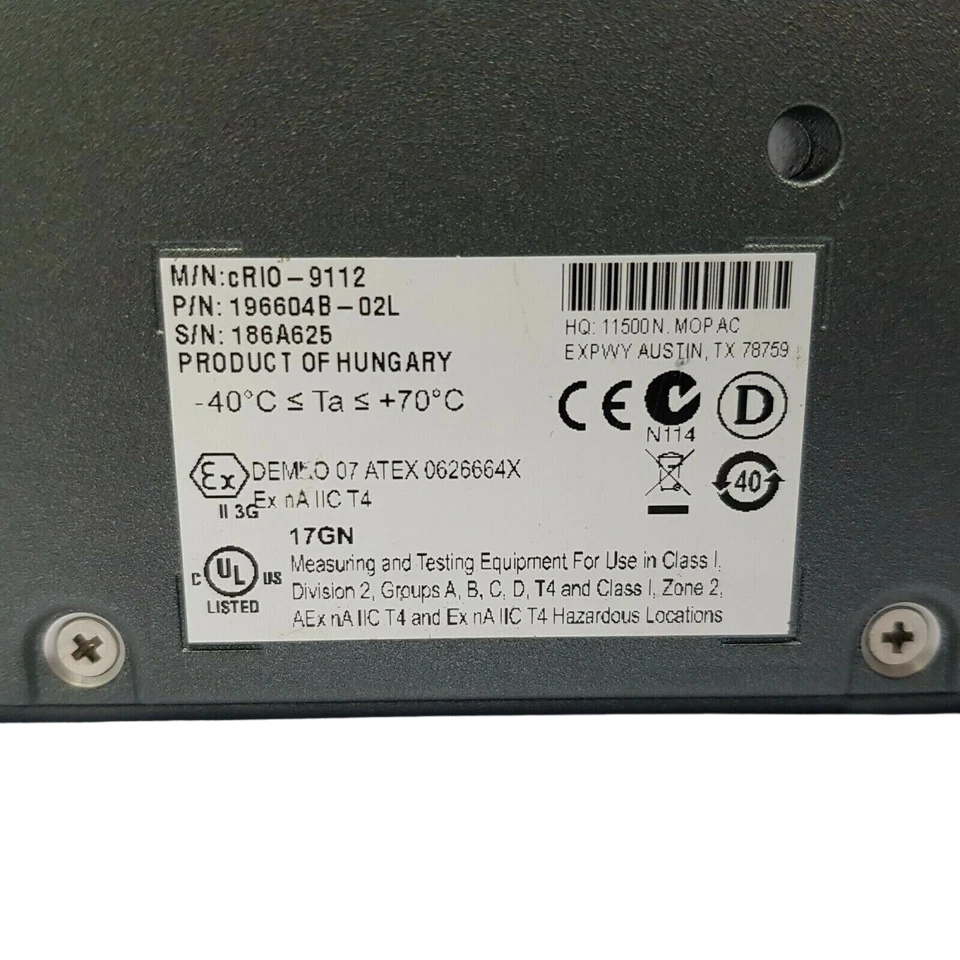
- Chassis Model: cRIO-9112
- Controller MPN: 780718-01 (Standard conformal/uncoated), 196884-01 / 196884x (Sub-assembly board reference)
- Chassis MPN: 780916-01, 196604B-02L (PCB reference)
- Mating Power Connector Block: NI 9978 (4-position COMBICON screw terminal, Part Number: 196938-01)
- Chassis DIN-Rail Mounting Kit: NI 9915 (Part Number: 779018-01 for 8-slot chassis)
Technical Specifications
| Parameter | Specification Details |
|---|---|
| Processing Core | Freescale MPC8347 PowerPC @ 533 MHz; Real-time execution via Wind River VxWorks |
| Memory Subsystem | 256 MB DDR2 DRAM system memory; 2 GB nonvolatile NAND flash storage |
| FPGA Architecture | Xilinx Virtex-5 LX30 (19,200 LUTs, 19,200 Flip-Flops, 32 DSP48 slices, 1,152 kbits Block RAM) |
| Chassis Expansion Capacity | 8 slots for C Series I/O modules; dedicated FPGA line access per slot |
| Primary Power Supply Input | Dual diode-OR redundant inputs (V1, V2); 9 to 35 VDC on power-up (6 to 35 VDC post-boot sustain) |
| Power Consumption | Controller alone: ~7.5 W; Max system dissipation (fully loaded with 8 C Series modules): 35 W |
| Terminal Connections | 4-position detachable screw terminal COMBICON (V1, V2, C, C); 12–18 AWG copper wire; 0.5–0.6 N·m torque |
| Network Interfaces | Port 1: 10/100/1000Base-T (RJ-45 auto-negotiation, IEEE 802.3); Port 2: 10/100Base-TX (RJ-45) |
| Serial & Peripheral I/O | 1x RS-232 DTE DB-9 (300 to 230,400 bps; RTS/CTS, XON/XOFF); 1x USB 2.0 Hi-Speed Host (480 Mb/s, Type-A with locking screw standoff) |
| Ingress Protection | IP40 (enclosure requirement: minimum IP54 for Zone 2 hazardous installations) |
| Operating Temperature | cRIO-9022 Controller: -20 °C to +55 °C; cRIO-9112 Chassis: -40 °C to +70 °C |
| Vibration & Shock Ratings | Vibration: 5 g RMS random (10 to 500 Hz), 5 g sinusoidal (10 to 500 Hz); Shock: 30 g (11 ms half-sine), 50 g (3 ms half-sine) across 18 orientations |
| Physical Dimensions & Mass | Combined dimensions: approx. 274 mm × 88.1 mm × 93.1 mm; Chassis mass: 880 g; Controller mass: 609 g |
Controller Power Connector (COMBICON 4-Position Terminal)
The cRIO-9022 accepts dual power inputs to provide power redundancy without external steering diodes. The controller automatically draws current from whichever input maintains the higher potential (requiring at least a 500 mV differential to select a distinct supply).
- Terminal V1: Primary DC Power Positive (+9 VDC to +35 VDC input)
- Terminal V2: Secondary/Redundant DC Power Positive (+9 VDC to +35 VDC input)
- Terminal C (Pin 3): Common Ground Return (internally tied)
- Terminal C (Pin 4): Common Ground Return (internally tied)
- Chassis Ground Lug: M4 threaded ground point on chassis frame (must be connected to central star-earth via braided ground strap minimum 10 AWG / 4 mm²).
C Series Module Interoperability
- Analog Input: NI 9201, NI 9205 (voltage), NI 9203, NI 9208 (current loop, 4–20 mA), NI 9211/9213 (thermocouple), NI 9217/9219 (RTD/universal), NI 9234 (piezoelectric/IEPE vibration).
- Analog Output: NI 9263 (±10 V), NI 9265 (0–20 mA), NI 9269 (isolated channel-to-channel).
- Digital I/O: NI 9401 (high-speed TTL), NI 9421/9425 (sinking 24 V DC inputs), NI 9472/9474 (sourcing 24 V DC outputs), NI 9481/9485 (relay modules).
- Specialized Communication: NI 9853 / NI 9862 (High-Speed Controller Area Network / CAN), NI 9870 (RS-232 4-port expansion), NI 9871 (RS-485 4-port expansion).
Feaures
- Deterministic Real-Time Processing: Powered by an industrial 533 MHz Freescale MPC8347 processor with 256 MB DRAM running VxWorks RTOS, ensuring zero-jitter multi-loop execution and persistent local data acquisition.
- Reconfigurable Virtex-5 LX30 FPGA: True hardware-speed parallel control and custom timing logic executing on 19,200 logic elements without burdening host processor CPU bandwidth.
- High-Density 8-Slot Backplane: Accommodates up to 8 hot-swappable C Series conditioning modules across mixed-signal topologies (analog, digital, strain, temperature, serial, and CANbus).
- True Redundant Dual-Power Topology: Accepts dual wide-range DC inputs (9–35 VDC) with automatic diode-OR failover switching to ensure continuous uptime during supply dips.
- Hardened Industrial Chassis: Tested for 50 g mechanical shock, 5 g continuous operational vibration, and hazardous location certifications (Class I, Div 2 / ATEX Zone 2).
Frequently Asked Questions
Can the NI cRIO-9022 boot and operate directly from a single 12 V or 24 V DC power supply?
Yes. The controller is designed with a wide-input power converter that accepts 9 to 35 VDC for boot startup, and can sustain operation down to 6 VDC after initialization. Connecting a single clean 12 VDC or 24 VDC industrial power source to terminal V1 and terminal C provides full system functionality. The V2 terminal can be utilized simultaneously for secondary backup power.
What is the primary difference between the cRIO-9112 and cRIO-9114 chassis?
Both are 8-slot reconfigurable CompactRIO backplanes, but they differ in FPGA capacity. The cRIO-9112 utilizes a Xilinx Virtex-5 LX30 FPGA (19,200 logic cells and 32 DSP slices), whereas the cRIO-9114 features a larger Virtex-5 LX50 FPGA (28,800 logic cells and 48 DSP slices). The cRIO-9112 is ideal for standard deterministic control and high-speed data acquisition; the cRIO-9114 is chosen when extensive multichannel onboard signal processing, filtering, or FFT analysis is compiled directly into the FPGA.
Can I install and remove C Series modules while the cRIO-9022 / cRIO-9112 system is powered?
The C Series hardware architecture allows hot-swapping of modules in non-hazardous industrial areas without powering down the entire chassis. However, National Instruments requires disconnecting external line-power voltages from the module’s I/O terminals before insertion or extraction. If the equipment is mounted in an ATEX Zone 2 or Class I, Div 2 hazardous location, you must ensure the area is non-hazardous or power off the entire system before module manipulation.
How do I configure IP addresses across the dual Ethernet ports on the cRIO-9022?
The two RJ-45 ports function as separate physical network interfaces. Through NI Measurement & Automation Explorer (NI MAX), configure each port on distinct IP subnets (for example, assign Port 1 to 192.168.1.xxx for the control network and Port 2 to 10.0.0.xxx for the plant instrumentation network). Bridging or assigning identical subnets to both ports will cause packet routing collisions in the VxWorks network stack.
Which LabVIEW version is recommended for new deployments of the cRIO-9022 / cRIO-9112?
For maintaining or commissioning these legacy hardware sets, LabVIEW 2017 SP1, 2018 SP1, or 2019 SP1 with corresponding CompactRIO drivers offer stable real-time compilers for the PowerPC MPC8347 processor and Virtex-5 LX30 FPGA targets. Always verify that your installed LabVIEW FPGA compilation tools support the Xilinx ISE 14.7 toolchain required for Virtex-5 hardware synthesis.