

Blog
Honeywell Expands NOTIFIER INSPIRE & CLSS Life Safety Ecosystem

Next-Gen Fire Safety: An Engineering Look at Honeywell’s New Integrated Smoke Control & CLSS Platform
In industrial and commercial automation, fire safety has long suffered from a structural headache: fragmentation. For years, commissioning a reliable fire and life safety system meant stitching together isolated panels, writing complex logic equations, and dealing with extensive proprietary hardware just to make HVAC dampers, fans, and smoke detectors talk to one another cleanly.
Honeywell’s latest expansion of its fire portfolio – specifically the next generation of smoke control within the NOTIFIER INSPIRE™ series and new updates to the Connected Life Safety Services (CLSS) cloud platform – tackles this fragmentation head-on.
From a systems engineering perspective, this update shifts fire protection from a series of manual, siloed components to a unified, software-mapped ecosystem. Here is a technical breakdown of what these innovations bring to the field.
Streamlining Smoke Control via Virtual Software Architecture
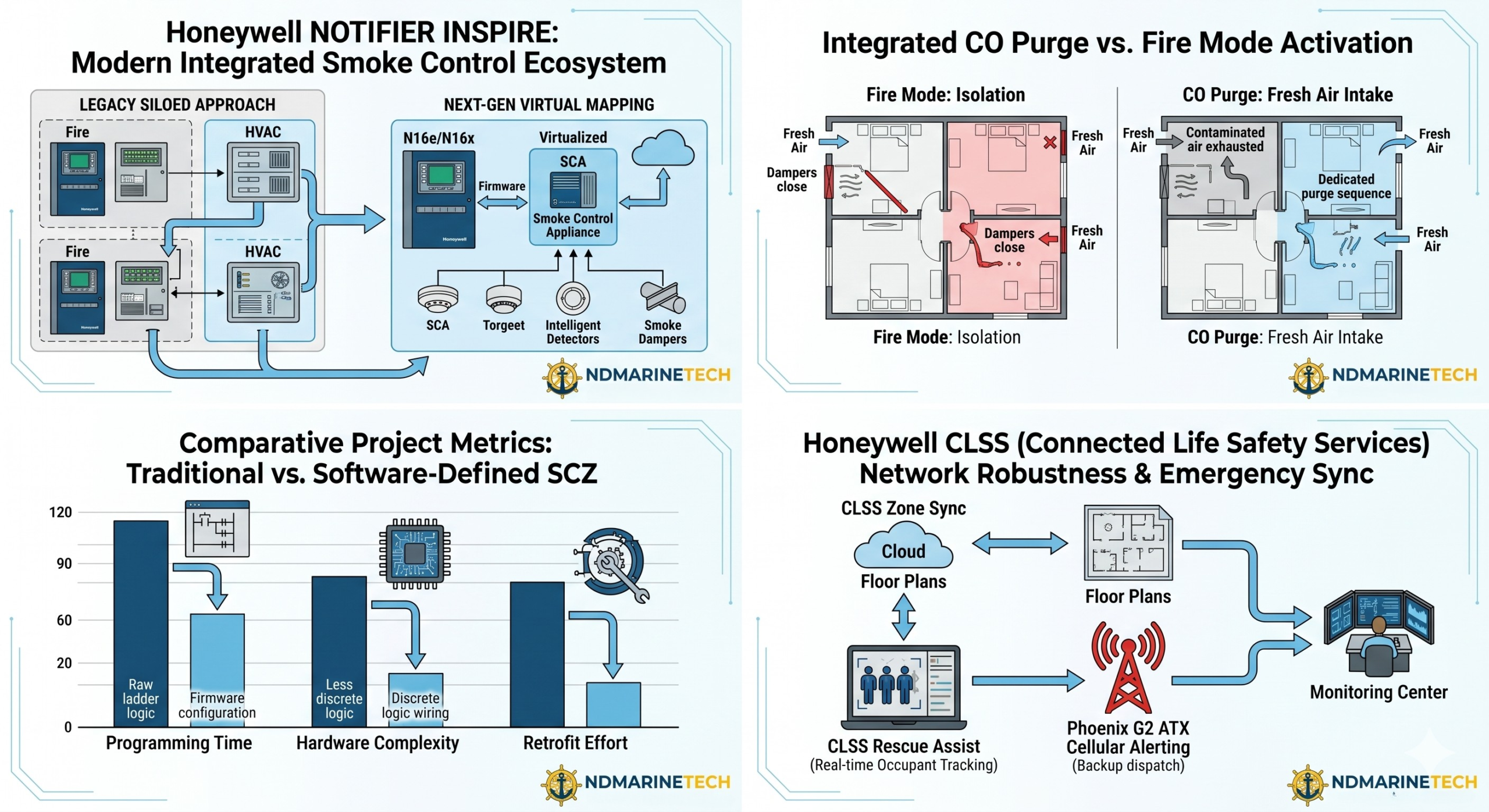
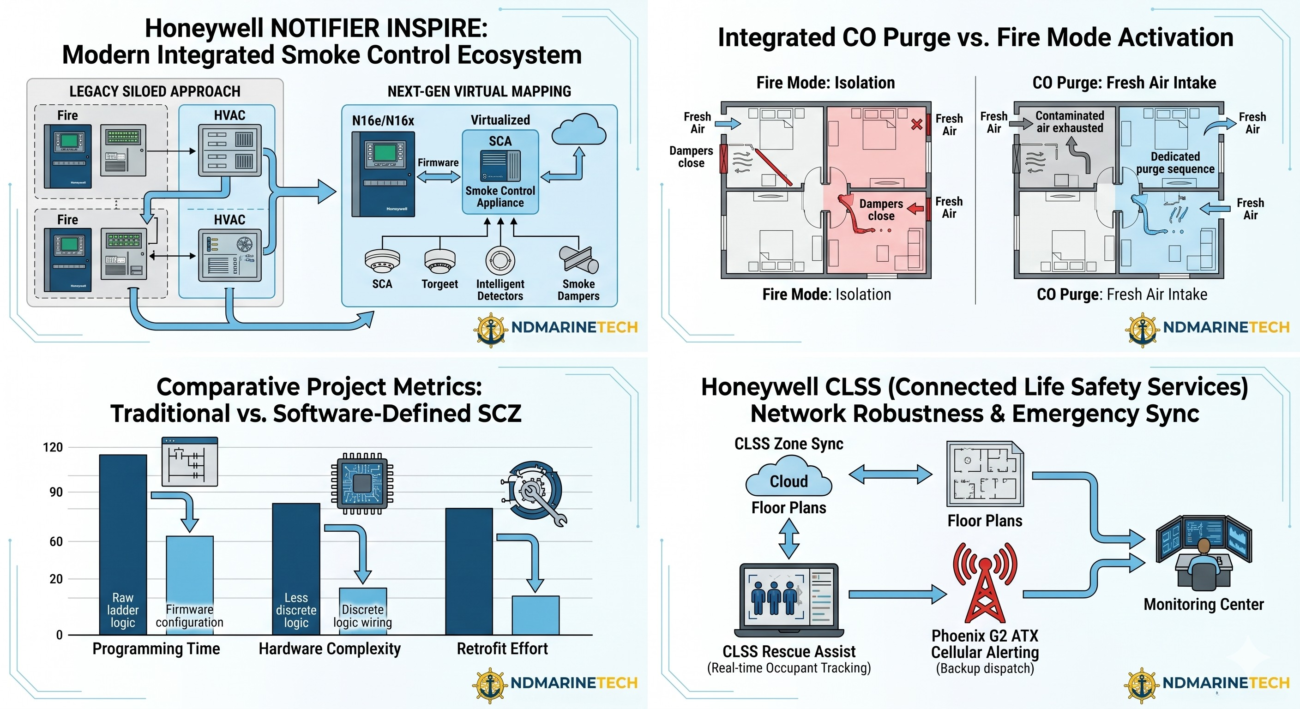
Historically, setting up a Smoke Control Zone (SCZ) required heavy custom logic programming to ensure that when a fire alarm fires, the correct dampers close to isolate oxygen while exhaust fans open to clear pathways.
Honeywell is moving away from this legacy approach by implementing a specialized firmware engine in its modern intelligent panels (like the NOTIFIER INSPIRE N16e and N16x series). This engine maps physical smoke control hardware and its associated control or monitor modules directly to a virtual Smoke Control Appliance (SCA point).
Why This Architecture Is Important:
- Logic Equations Reduction: Native handling of activation precedence, lockouts and synchronized operation in software instead of in raw ladder logic reduces development times substantially.
- Simplified Retrofits: It makes renovating older facilities practical. The systems can be cognitively remapped to fit within the new panel architecture, rather than taking out current physical infrastructure to match new hardware limits.
- AHJ Compliance: Built in automated testing and centralized reporting help make passing local Authority Having Jurisdiction (AHJ) and NFPA 72 inspection workflows substantially cleaner.
Growing the Cloud Ecosystem: Zone Sync, Rescue Assist, and Cellular Redundancy
The effectiveness of a fire panel is only as good as the real-time data it delivers to building operators and first responders. Honeywell also made three important additions to its cloud-connected CLSS platform in addition to the hardware upgrades:
1) CLSS Zone synchronization
When business floor plans are retrofitted or updated spatially, a serious disconnect can occur between the physical layout of the space and the digital device mapping maintained in the fire system. Zone Sync is a continuous, automatic bridge. This guarantees that floor plans, individual device mapping records and defined alarm zones are exactly aligned on all remote and on-site interfaces, providing an immutable source of truth for first responders.
2) CLSS Rescue Assist
Disorganization may occur during a critical alarm when tracking people who need specific physical help. This software tool provides real-time visibility on who needs help and where they are within the building for emergency teams and incoming responders, easing evacuation logistics.
3) Phoenix G2 ATX Cellular Alerting
Unfortunately, network drops do occur during catastrophic occurrences. By adding USDD’s Phoenix G2 cellular alerting technology into the platform, the ecosystem now has a tough, redundant cellular backup pipeline. Multi-carrier cellular backup (major carriers including Verizon, AT&T, and T-Mobile) provides a way to ensure crucial dispatch notifications can continue to route efficiently, even if a local facility network or hardline internet infrastructure is taken down by fire damage.
Verdict:
Unified cloud monitoring and virtualized device mapping is old hat for the maritime and industrial automation specialists, but taking it a step further and integrating it into life safety is a giant leap ahead. These upgrades tackle some of the most persistent deployment pain points in the industry by reducing reliance on bespoke hardwired logic, limiting unnecessary equipment, and providing backup with cloud-to-cellular redundancy.
Source of article: Honeywell